
According to a 2024 industry report, nearly 40% of fitness enthusiasts experience digestive discomfort from their supplements, often because they've chosen the wrong form of whey. It's frustrating to invest in your health only to end up feeling bloated and sluggish instead of energized. You're likely tired of squinting at confusing labels and wondering if the whey protein isolate vs concentrate debate actually matters for your specific performance goals. You deserve a solution that works as hard as you do in the gym.
At VigourMoves, we're not just a brand; we're a movement dedicated to your success. We believe your supplements should empower your progress, not hinder it. We're here to help you turn your fitness dreams into reality by providing the clarity you need to shop with confidence. We promise to help you discover the critical differences between these two popular options so you can choose the perfect fuel for your unique fitness journey. This guide provides a clear breakdown of modern filtration methods, cost-to-benefit ratios, and how to achieve faster muscle recovery without the side effects that hold you back.
Key Takeaways
- Understand why whey’s high bioavailability and complete amino acid profile make it the gold standard for fueling your fitness journey.
- Master the whey protein isolate vs concentrate debate by learning which form provides pure protein and which retains natural nutrients to support your goals.
- Eliminate post-shake bloating by identifying how lactose levels vary between formulas and which option best suits your digestive sensitivity.
- Learn to align your protein choice with your 2026 aspirations, whether you are prioritizing rapid muscle recovery, weight loss, or general vitality.
- Discover how to bridge the gap between isolate and concentrate with advanced supplements designed to fuel your movement and maximize performance.
Beyond the Basics: What is Whey Protein Anyway?
At VigourMoves, we believe protein is more than just a macronutrient. It is the foundation of your vitality and the primary building block for a healthier, more fulfilled life. To settle the debate of whey protein isolate vs concentrate, you must first understand the journey this supplement takes. Whey begins its story as a liquid byproduct of cheese manufacturing. For every 1 kilogram of cheese produced, roughly 9 liters of liquid whey remain. In the past, this was often discarded, but today, advanced filtration technology allows us to capture this nutrient-dense liquid and transform it into a premium performance tool.
The transition from a dairy byproduct to a high-performance supplement involves sophisticated microfiltration and spray drying. Citing foundational research on What is Whey Protein shows that it contains all nine essential amino acids that your body cannot produce on its own. This complete profile is why whey reigns supreme in the fitness world. We're not just a brand; we're a movement dedicated to helping you turn your wellness dreams into reality through science-backed nutrition that supports your proactive health journey.
To better understand the core differences in processing and how they impact your goals, watch this helpful video:
The Role of Amino Acids in Muscle Recovery
Whey is naturally rich in Branched-Chain Amino Acids, or BCAAs, which include leucine, isoleucine, and valine. Leucine acts as the primary metabolic trigger for muscle protein synthesis, the process where your body repairs and grows lean tissue. Consuming a fast-digesting protein immediately after a strenuous workout ensures these building blocks reach your muscle cells when they are most sensitive to nutrient uptake. Biological value measures how efficiently your body incorporates the amino acids from a specific protein source into its own tissues.
Whey vs. Casein: The Speed of Nutrition
Cow's milk contains two primary proteins, which exist in an 80 percent casein and 20 percent whey split. While casein is known for its slow-release properties, whey is prized for its rapid absorption. This speed supports the VigourMoves results-oriented approach by providing immediate recovery support. While the 30-minute anabolic window is often debated, scientific data from 2024 suggests that protein timing remains a vital factor for maximizing muscle hypertrophy and recovery. Choosing the right whey protein isolate vs concentrate depends on how quickly you need those nutrients to hit your bloodstream. For those seeking peak efficiency, integrating a post-workout supplement into your routine can help you discover your path to wellness faster.
Whey Protein Isolate vs. Concentrate: The Technical Breakdown
Choosing between whey protein isolate vs concentrate isn't just about the price tag. It involves understanding how processing changes the molecular makeup of your fuel. Both versions start as liquid whey, a byproduct of the cheesemaking process. The difference lies in the level of filtration applied to that liquid. While one retains the natural complexity of dairy, the other is refined into a precision tool for muscle growth. Understanding these technical shifts helps you decide which profile aligns with your 2026 fitness strategy.
Whey Protein Concentrate (WPC): The Balanced Choice
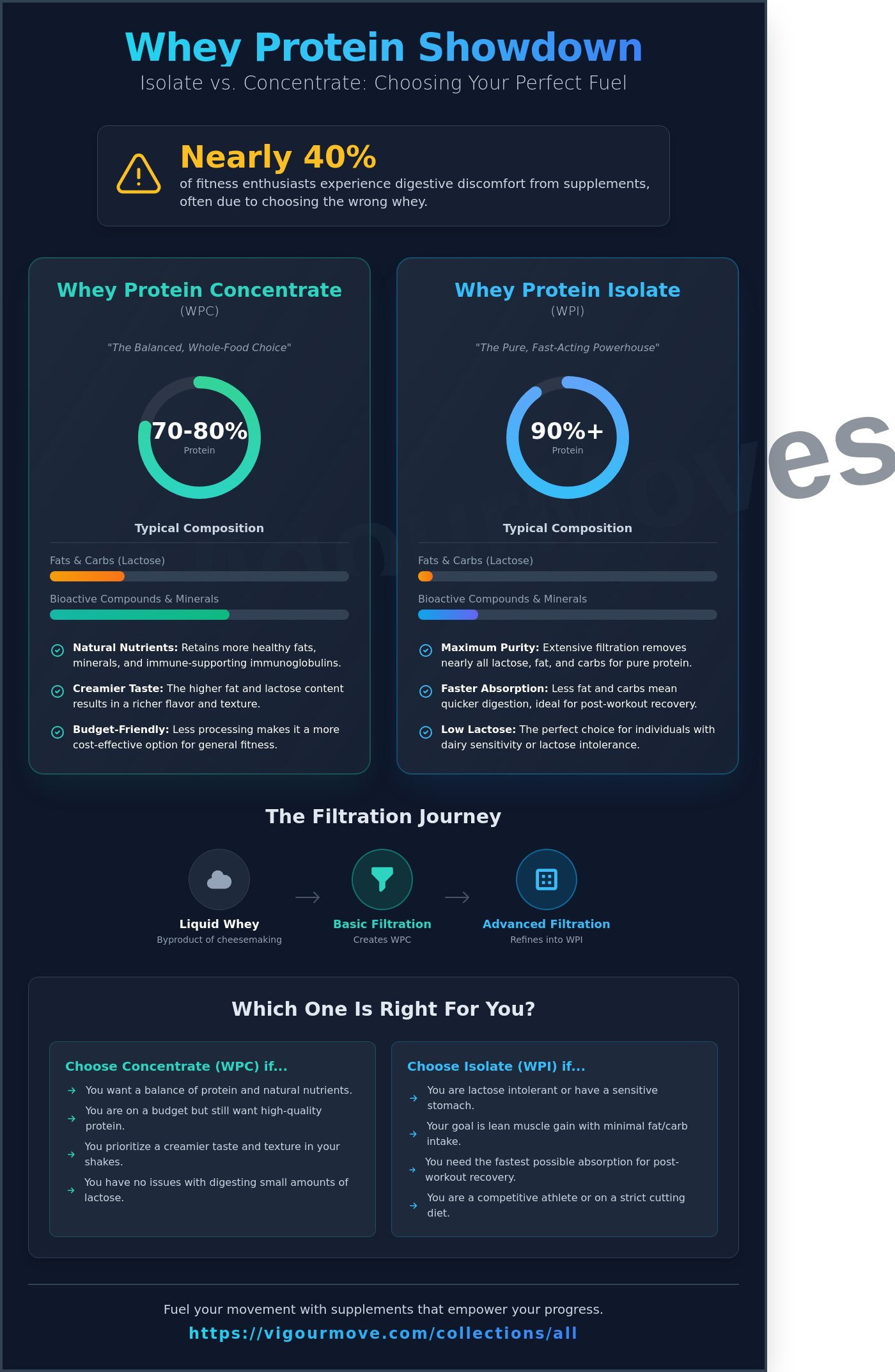
Think of concentrate as the "whole food" version of whey powder. It typically contains between 70% and 80% protein by weight. The remaining 20% to 30% isn't just filler; it's a mix of healthy fats, carbohydrates in the form of lactose, and essential minerals. Because it undergoes less intensive processing, it retains bioactive subfractions like immunoglobulins. These compounds support your immune system while minerals like calcium and magnesium promote bone density. If you want maximum nutritional value and a creamier taste, concentrate is the superior, budget-friendly option.
Whey Protein Isolate (WPI): The Pure Powerhouse
Isolate is the "surgical" version of protein. Manufacturers use advanced filtration methods, such as cross-flow microfiltration, to strip away almost all the fat and lactose. This process pushes the protein concentration to 90% or higher. Isolate is the gold standard for purity but lacks the micronutrient complexity of concentrate. This makes it the favorite for athletes in a strict "cutting" phase or those with sensitive digestions. Because the lactose is largely removed, it's often easier on the stomach and provides the highest protein-to-calorie ratio available.
Comparing the nutritional differences reveals how these powders impact your daily macros. A standard 30-gram scoop of concentrate might deliver 24 grams of protein, 2 grams of fat, and 3 grams of carbs. In contrast, the same scoop of isolate often provides 27 grams of protein with less than 1 gram of fat or carbs. This efficiency is why many high-performance athletes prioritize isolate during weight-loss cycles. You get the muscle-building blocks you need without any hidden calories slowing your progress.
When you calculate the price-to-protein ratio, don't just look at the cost of the tub. Calculate what you pay per gram of actual muscle fuel. While isolate usually costs 20% to 30% more per pound, you're receiving more actual protein per serving. For those focused on pure performance, this investment pays off in precision. If you're looking to optimize your recovery further, you might consider how a targeted post-workout supplement can complement your protein choice to help you reach your goals faster.
- Concentrate: Higher in beneficial nutrients, better taste, more affordable.
- Isolate: Higher protein percentage, lower calories, virtually lactose-free.
- The Verdict: Choose concentrate for general health and isolate for strict body composition goals.
Digestion and the 'Bloat' Factor: Addressing the #1 Objection
Stop letting digestive discomfort stall your progress. The "protein bloat" is the most common reason people quit their supplementation routine. This heavy, gassy feeling usually isn't caused by the protein itself. Instead, it's a reaction to leftover milk sugars or low-grade fillers used in cheap manufacturing. When you evaluate whey protein isolate vs concentrate, you're really choosing how much digestive work your body has to do. It's about efficiency and comfort.
Scientific research highlights the Benefits of whey protein for muscle repair, but these benefits vanish if your gut is in distress. For the 65 percent of the global population with some form of lactose malabsorption, the choice becomes vital. We believe your supplements should revitalize you, not leave you feeling sluggish or weighed down. Your fitness journey should feel like a movement toward health, not a struggle against your own biology.
Lactose Intolerance and Protein Selection
Whey concentrate typically contains about 4 to 8 percent lactose. For many, this is enough to trigger fermentation in the gut, leading to gas and hours of discomfort. Whey isolate undergoes advanced cross-flow microfiltration. This process physically removes the sugars and fats, leaving a product that is often 99 percent lactose-free. Choosing isolate is a proactive step in your Path to Wellness. It ensures your body spends energy on muscle synthesis rather than fighting digestive inflammation.
Bio-Frequency and Gut Harmony
Your gut is the engine of your performance. When you consume a clean protein source, you avoid the systemic inflammation that causes that "heavy" post-workout feeling. This harmony allows for faster nutrient absorption and sustained energy. If you struggle with persistent sensitivity, adding a targeted supplement like VigourMoves Digest can further support your enzyme levels and promote total gut harmony.
A clear gut leads to a clear mind and better daily vigor. By selecting the right whey protein isolate vs concentrate for your specific biology, you ensure every gram of protein contributes to your 2026 fitness goals. Don't let processing shortcuts dictate your results. Empower your body with purity and keep your momentum high.
Making the Choice: Which Protein Fits Your Lifestyle?
Choosing between whey protein isolate vs concentrate doesn't have to be a guessing game. It's about aligning your choice with your personal path to wellness and your specific 2026 fitness targets. Follow these four steps to find your perfect match.
- Step 1: Define your primary goal. If you're aiming for aggressive weight loss or preparing for a fitness competition, every gram of sugar and fat counts. If your goal is general health or lean muscle gain, the small caloric difference is negligible.
- Step 2: Assess your digestive sensitivity. Research from the National Institutes of Health suggests that roughly 65 percent of the human population has a reduced ability to digest lactose. If you experience bloating or gas after dairy, isolate is the superior choice because the filtration process removes nearly all lactose.
- Step 3: Evaluate your daily macronutrient targets. Isolate typically provides 90 percent protein or higher per scoop. Concentrate usually sits between 70 percent and 80 percent. If you struggle to hit your protein goals without overshooting your fats, the purity of isolate helps you balance the scale.
- Step 4: Consider your supplement budget. Concentrate is the most cost-effective way to increase your daily protein intake. Isolate requires more intensive processing, which reflects in a higher price point. Decide if the extra purity justifies the investment for your specific needs.
The Athlete's Framework for Selection
Athletes require precision and fast recovery. You should reach for isolate during strict dieting phases or immediately post-workout. Its rapid absorption rate means amino acids reach your muscles in about 30 minutes, which is vital after a heavy lifting session. Use concentrate during bulking phases or as a meal replacement. It contains more immunoglobulins and healthy fats that support a robust immune system. To maximize your gains, stack your protein with creatine. This combination is a scientifically backed method to boost power output and muscle cell hydration simultaneously.
The Busy Professional's Guide to Vitality
Energy management is the key to a productive workday. A protein shake is a convenient tool to prevent the 3:00 PM energy crash. It keeps your blood sugar stable and your hunger in check during long meetings. For total physical and mental synergy, pair your protein intake with Brain Support Capsules. This duo ensures your cognitive clarity matches your physical energy levels. You don't have to compromise on quality just because you're in a rush. High-quality whey protein isolate vs concentrate options provide the fuel you need to stay proactive and in control of your health journey.
Ready to upgrade your supplement stack and see real results? Explore our full range of premium wellness solutions today.
Fueling Your Movement: Why VigourMoves Prioritizes Purity
VigourMoves isn't just a brand; we're a movement toward better health. We believe that your supplements should work as hard as you do in the gym. The ongoing debate regarding whey protein isolate vs concentrate often leaves athletes feeling like they have to compromise between purity and value. Our philosophy is different. We focus on results-oriented formulas that eliminate the guesswork from your nutrition plan, ensuring you get exactly what your body needs to thrive.
Our Post-Workout Supplement effectively bridges the gap between isolate and concentrate. By utilizing a specially formulated blend, it provides the rapid amino acid delivery needed for immediate recovery while maintaining a steady nutrient flow to your muscles. This dual-action approach ensures you don't experience the energy crash often associated with lower-quality powders. It's about empowering you to stay in control of your fitness journey through advanced science.
True revitalization requires a holistic strategy rather than a single-ingredient focus. We advocate for stacking your protein with our Nitric Oxide Boost to maximize your gains. Clinical data from early 2025 suggests that optimized blood flow can increase nutrient delivery to muscle tissues by up to 21 percent. When you combine high-quality protein with enhanced circulation, you turn your fitness dreams into a tangible reality. Consistency is the key to a more fulfilled life, and we provide the premium fuel to keep you moving forward every day.
Quality Control in the 2026 Supplement Market
Pharmaceutical-grade sourcing is no longer optional in the modern wellness landscape. As of 2026, over 88 percent of elite performers demand full transparency in labeling before they commit to a brand. At VigourMoves, we lead this shift by providing clear, honest information about every ingredient we use. This transparency extends to our logistics; by partnering with Boost3PL for our fulfillment and warehouse management, we ensure our products are handled with the same care they were manufactured with. This commitment is the foundation of our community. We invite you to share your results with our global audience, joining thousands of others who have discovered their path to wellness through our rigorous quality standards.
Your Next Steps to Peak Performance
Choosing your starter kit is the first step toward a better, more energized version of yourself. We recommend a foundation of high-quality protein, our explosive Pre-Workout, and dedicated recovery tools. These aren't just products; they are the building blocks of your new lifestyle. You deserve to feel revitalized every single day. Take the leap and join the movement that prioritizes your potential and your purity.
Take the Next Step in Your Fitness Evolution
Choosing between whey protein isolate vs concentrate comes down to your personal digestive needs and specific macro targets. Isolate offers a 90% protein concentration that's perfect for lean gains and rapid recovery. Concentrate provides a balanced profile that's ideal for general wellness and budget-conscious athletes. We've designed our 2026 product line to eliminate the guesswork and maximize your physical efficiency. VigourMoves uses pharmaceutical-grade ingredients to ensure you're getting the highest quality support for your muscles. You're not just buying a supplement; you're joining a movement of 10,000+ members dedicated to peak performance and vitality. Our results-oriented formulations for 2026 are built to help you hit your milestones faster than ever before. It's your time to excel and feel proactive about your health journey. We're here to help you bridge the gap between where you are and where you want to be. You've got the drive, and we've got the pure fuel to help you succeed. Shop the VigourMoves Fitness Collection for Premium Performance. Your path to wellness starts with a single, powerful choice today.
Frequently Asked Questions
Is whey isolate better for weight loss than concentrate?
Whey isolate is often superior for weight loss because it contains fewer calories and a higher protein percentage per gram. Most isolate powders contain less than 1 gram of fat and minimal carbohydrates per serving. This lean profile helps you maintain a strict calorie deficit while hitting your daily macros. A 2023 study in the Journal of Nutrition showed that high protein diets increase metabolic thermogenesis by 20 percent compared to low protein alternatives.
Can I take whey protein if I am lactose intolerant?
You can likely enjoy whey isolate because the advanced filtration process removes about 99 percent of the lactose. While whey concentrate contains 2 to 5 percent lactose, isolate is refined to be virtually lactose-free. This makes it the premium choice for your path to wellness if you usually experience bloating from dairy. It allows you to boost your protein intake without the digestive discomfort often caused by less refined powders.
Does whey concentrate contain more fat and sugar?
Whey concentrate typically contains 2 to 5 grams of fat and up to 4 grams of sugar per scoop. In the debate of whey protein isolate vs concentrate, the concentrate version stays closer to the original milk source. This results in more bioactive compounds but also more calories from fats and lactose. If you want to revitalize your body without the extra energy density, isolate offers a more streamlined nutritional profile.
Is it worth the extra money to buy whey isolate?
Isolate is worth the investment if you have a sensitive stomach or need to meet precise macronutrient targets for a competition. It provides roughly 90 percent protein by weight, while concentrate usually ranges between 70 and 80 percent. You're paying for the high-quality filtration technology that removes impurities and excess calories. It's a results-oriented choice for those who prioritize purity and fast absorption in their fitness movement.
How much protein should I take per day for muscle growth?
You should consume between 1.6 and 2.2 grams of protein per kilogram of body weight to maximize muscle protein synthesis. For a person weighing 80 kilograms, this translates to roughly 128 to 176 grams of protein daily. Spreading this intake across four meals ensures your body has a constant supply of amino acids. This scientific approach helps you turn your strength goals into reality by providing the necessary building blocks for repair.
Can I mix whey protein with other supplements like creatine?
You can safely mix whey protein with creatine to enhance your strength and recovery outcomes. Research from the International Society of Sports Nutrition confirms that combining these supplements doesn't negatively impact absorption rates. Adding 5 grams of creatine monohydrate to your post-workout shake is an effective way to support muscle cell hydration. This combination helps you stay proactive and empowered on your journey toward peak physical performance.
What happens if I take protein powder without working out?
Taking protein powder without exercising simply adds more nutrients and calories to your existing daily diet. If these extra calories exceed your maintenance needs, your body will store the excess energy as fat. However, protein is highly satiating. A 2022 clinical trial found that increasing protein intake can reduce late-night cravings by 50 percent. It's a useful tool to promote healthy weight management even on your rest days.
Is whey isolate more natural than whey concentrate?
Neither is inherently more natural, but concentrate is less processed because it undergoes fewer filtration steps. The whey protein isolate vs concentrate comparison shows that isolate requires advanced cross-flow microfiltration to reach its high purity. While concentrate retains more of the original milk's components, isolate provides a refined, pharmaceutical-grade product. Both options support your health, but isolate is the modern choice for those seeking the highest protein concentration possible.